
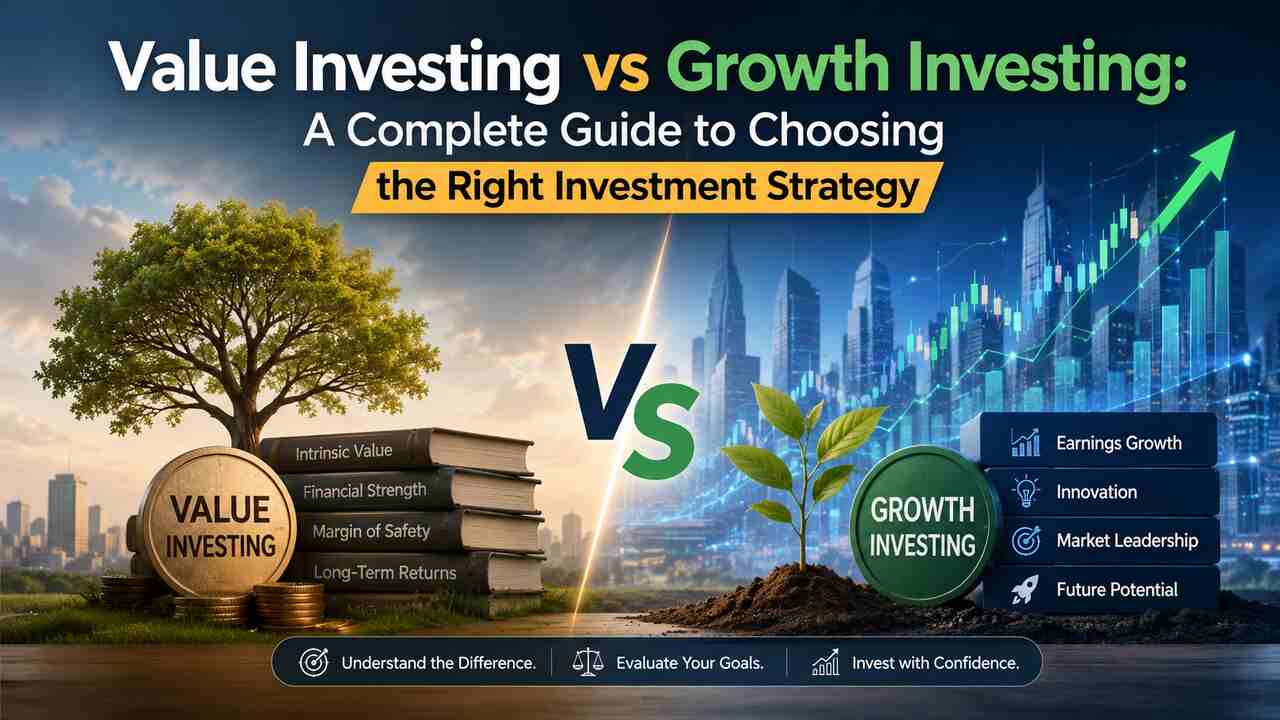

Investing in the stock market involves making decisions that align with financial goals, risk tolerance, and investment timelines. Among the most influential approaches, value investing and growth investing stand out as two distinct strategies that have shaped generations of successful investors. Each method focuses on different characteristics of companies, market behavior, and long-term wealth creation.
While some investors seek companies trading below their intrinsic worth, others prefer businesses capable of delivering rapid earnings expansion. Understanding the differences between these strategies can help investors build stronger portfolios and avoid common mistakes. This guide explores both approaches in depth, compares their strengths and weaknesses, explains when each performs best, and helps you determine which investment style fits your financial objectives.
Understand the Core Principles of Value Investing
Value investing focuses on purchasing stocks that appear undervalued compared to their intrinsic value. Investors believe that the market occasionally misprices companies due to temporary economic conditions, negative sentiment, or short-term uncertainty. The objective is to buy quality businesses at a discount and wait for the market to recognize their true worth.
This strategy emphasizes financial strength, consistent profitability, stable cash flow, and reasonable valuation metrics. Investors typically examine earnings, assets, debt levels, dividends, and historical performance before purchasing a stock.
Benjamin Graham introduced the foundation of value investing, while Warren Buffett expanded the philosophy by emphasizing wonderful companies purchased at fair prices rather than simply cheap companies. Today, value investors continue to analyze balance sheets, income statements, and competitive advantages before making investment decisions.
Common Characteristics of Value Stocks
| Characteristic | Description |
| Low Price-to-Earnings Ratio | Stock trades below industry averages |
| Low Price-to-Book Ratio | Market value is close to asset value |
| Strong Cash Flow | Business consistently generates cash |
| Dividend Payments | Many value companies return profits to shareholders |
| Mature Business Model | Established companies with predictable earnings |
| Stable Revenue | Less volatile than high-growth firms |
Evaluate Companies Using Value Investing Metrics
Successful value investors rely on several financial measurements to determine whether a stock is undervalued. These metrics provide insight into valuation, profitability, and financial health.
The Price-to-Earnings (P/E) ratio compares a company’s stock price with its earnings per share. A relatively low P/E may indicate an undervalued opportunity, although industry comparisons are essential.
The Price-to-Book (P/B) ratio evaluates market value against net assets. Companies with lower P/B ratios often attract value investors, particularly in banking, manufacturing, and insurance sectors.
Free cash flow, dividend yield, return on equity (ROE), debt-to-equity ratio, and operating margin also contribute to determining whether a company possesses long-term investment potential.
Investors should avoid relying on a single metric. Instead, combining several financial indicators creates a more accurate assessment of intrinsic value.
Identify the Foundations of Growth Investing
Growth investing targets companies expected to increase revenue, earnings, and market share faster than the overall market. Investors prioritize future expansion over current valuation.
Growth companies often reinvest profits into innovation, research, acquisitions, technology, and customer acquisition instead of paying dividends. These businesses typically operate in industries experiencing rapid change or technological advancement.
Rather than asking whether a stock is cheap today, growth investors ask whether the company’s earnings can increase significantly over the next five to ten years.
Technology, healthcare innovation, artificial intelligence, cloud computing, renewable energy, and biotechnology frequently produce companies that fit growth investing criteria.
Common Characteristics of Growth Stocks
| Characteristic | Description |
| High Revenue Growth | Rapid expansion year after year |
| Strong Earnings Growth | Increasing profits over time |
| High P/E Ratio | Investors pay a premium for future potential |
| Limited Dividends | Profits are reinvested into expansion |
| Innovative Products | Continuous product development |
| Expanding Market Share | Capturing new customers consistently |
Analyze Growth Investing Indicators Before Buying Stocks
Growth investing requires evaluating future business potential rather than focusing exclusively on present valuation.
Revenue growth remains one of the strongest indicators because rapidly expanding sales often lead to increased profitability over time. Investors also examine earnings-per-share growth, gross margins, customer acquisition rates, recurring revenue, and management execution.
Competitive advantages become increasingly important when assessing long-term growth. Businesses with strong brands, proprietary technology, network effects, patents, or high customer loyalty often sustain growth for many years.
Industry trends also influence investment decisions. Companies operating in expanding markets usually enjoy stronger growth opportunities than those in mature industries.
Although growth companies may appear expensive based on traditional valuation measures, investors expect future earnings to justify higher prices.
Compare Value Investing and Growth Investing Across Key Factors
Although both strategies seek long-term wealth creation, they differ significantly in valuation methods, investment philosophy, risk profile, and expected returns.
| Feature | Value Investing | Growth Investing |
| Primary Goal | Buy undervalued companies | Buy fast-growing companies |
| Stock Valuation | Low valuation | Higher valuation |
| Dividend Income | Common | Rare |
| Risk Level | Moderate | Moderate to High |
| Earnings Growth | Stable | Rapid |
| Investment Horizon | Long-term | Long-term |
| Market Sectors | Financials, Utilities, Consumer Staples | Technology, Healthcare, Communication |
| Market Expectations | Recovery in valuation | Continued expansion |
| Volatility | Lower | Higher |
| Primary Focus | Intrinsic value | Future earnings potential |
Both strategies require patience. However, the reasons for holding investments differ considerably. Value investors wait for market recognition, while growth investors wait for business expansion.
Assess the Risks Associated With Each Strategy
Every investment strategy carries risk, and understanding these risks improves decision-making.
Value investing may expose investors to value traps. These occur when stocks appear inexpensive because the company’s underlying business continues to deteriorate. Declining industries, poor management, or structural changes can prevent prices from recovering.
Growth investing faces valuation risk. Investors may pay excessive prices based on optimistic expectations. If growth slows even slightly, stock prices can decline sharply.
Economic cycles also influence both strategies differently. Rising interest rates often pressure growth stocks because future earnings become less valuable when discounted at higher rates. Value stocks sometimes perform better during inflationary environments due to stronger current cash flows.
Diversification helps reduce risks regardless of investment style.
Build a Portfolio That Matches Your Investment Goals
Portfolio construction depends on personal financial objectives rather than choosing a universally superior strategy.
Investors seeking stable income, lower volatility, and consistent dividend payments often prefer value stocks. These companies generally produce predictable earnings and demonstrate resilience during economic uncertainty.
Investors with longer investment horizons and greater risk tolerance may prefer growth stocks because they offer the possibility of significant capital appreciation.
Many experienced investors combine both strategies. A diversified portfolio containing value and growth companies can reduce concentration risk while benefiting from different market environments.
Asset allocation should also consider bonds, international equities, real estate investments, and cash reserves.
Recognize Market Conditions That Favor Each Strategy
Different economic environments influence investment performance.
During economic recoveries, financial institutions, industrial companies, energy firms, and cyclical businesses frequently outperform, benefiting value investors.
Growth investing often excels during periods of technological innovation, low interest rates, expanding consumer spending, and strong corporate investment.
Inflation, monetary policy, interest rates, corporate earnings, and investor sentiment all influence whether value or growth stocks outperform over a given period.
Market leadership frequently rotates between the two strategies. Long-term investors should avoid constantly switching approaches based solely on recent performance.
Select Industries That Align With Each Investment Style
Certain industries naturally fit one investment philosophy more than the other.
Value-oriented sectors commonly include:
- Financial services
- Utilities
- Energy
- Consumer staples
- Industrial manufacturing
- Telecommunications
- Insurance
Growth-oriented sectors often include:
- Software
- Artificial intelligence
- Cloud computing
- Semiconductors
- Biotechnology
- Renewable energy
- E-commerce
- Digital payments
Industry selection should always include analysis of competitive positioning, earnings quality, and long-term demand trends.
Apply Fundamental Analysis Before Making Investment Decisions
Regardless of investment style, fundamental analysis remains essential.
Investors should review annual reports, quarterly earnings, management guidance, competitive positioning, operating margins, debt obligations, and cash flow generation before purchasing shares.
Understanding the company’s business model provides insight beyond financial ratios. Sustainable competitive advantages, experienced leadership, product innovation, customer retention, and efficient capital allocation often separate long-term winners from temporary market favorites.
Macroeconomic conditions should also influence investment decisions. Inflation, recession risks, interest rate changes, consumer spending, and regulatory developments affect industries differently.
Combining qualitative analysis with financial data produces more informed investment decisions.
Avoid Common Mistakes When Choosing an Investment Strategy
Many investors underperform because they make emotional rather than analytical decisions.
Common mistakes include:
- Chasing stocks after major price increases.
- Buying low-priced stocks without researching fundamentals.
- Ignoring company debt levels.
- Assuming high growth automatically guarantees strong returns.
- Selling quality investments during temporary market declines.
- Failing to diversify across sectors and investment styles.
- Overreacting to short-term market volatility.
- Ignoring valuation when purchasing growth companies.
Discipline, patience, and continuous learning remain among the most valuable qualities for long-term investing success.
Combine Value and Growth Investing for Balanced Returns
Many professional portfolio managers blend value and growth investing instead of treating them as mutually exclusive.
A balanced strategy may allocate capital toward established dividend-paying businesses while also investing in innovative companies capable of substantial future growth.
This blended approach reduces dependence on a single market cycle. When growth stocks experience volatility, value holdings may provide stability. Conversely, during technology-driven expansions, growth companies can significantly enhance portfolio returns.
Periodic portfolio rebalancing helps maintain target allocations while reducing excessive exposure to any one investment style.
Conclusion
Value investing and growth investing represent two proven approaches to building long-term wealth, yet they rely on fundamentally different philosophies. Value investing seeks quality businesses trading below intrinsic value, emphasizing financial strength, reasonable valuations, and patient investing. Growth investing focuses on companies with exceptional expansion potential, innovation, and accelerating earnings, accepting higher valuations in exchange for future opportunities.
Neither strategy consistently outperforms the other in every market environment. Economic conditions, interest rates, industry trends, and investor sentiment all influence which style leads during a given period. For many investors, combining value and growth stocks creates a more resilient portfolio capable of adapting to changing market cycles.
The most effective investment strategy is one that aligns with your financial goals, time horizon, and tolerance for risk. By understanding the principles, evaluation methods, advantages, and limitations of both approaches, investors can make informed decisions and build portfolios designed for sustainable long-term success.
